
Running the business
Sales Happens in Someone's Notebook: Why CRM Projects Fail
A real job advert admitted what most service businesses know: sales in a notebook, data in five places, no written process. Here is why CRM projects fail.
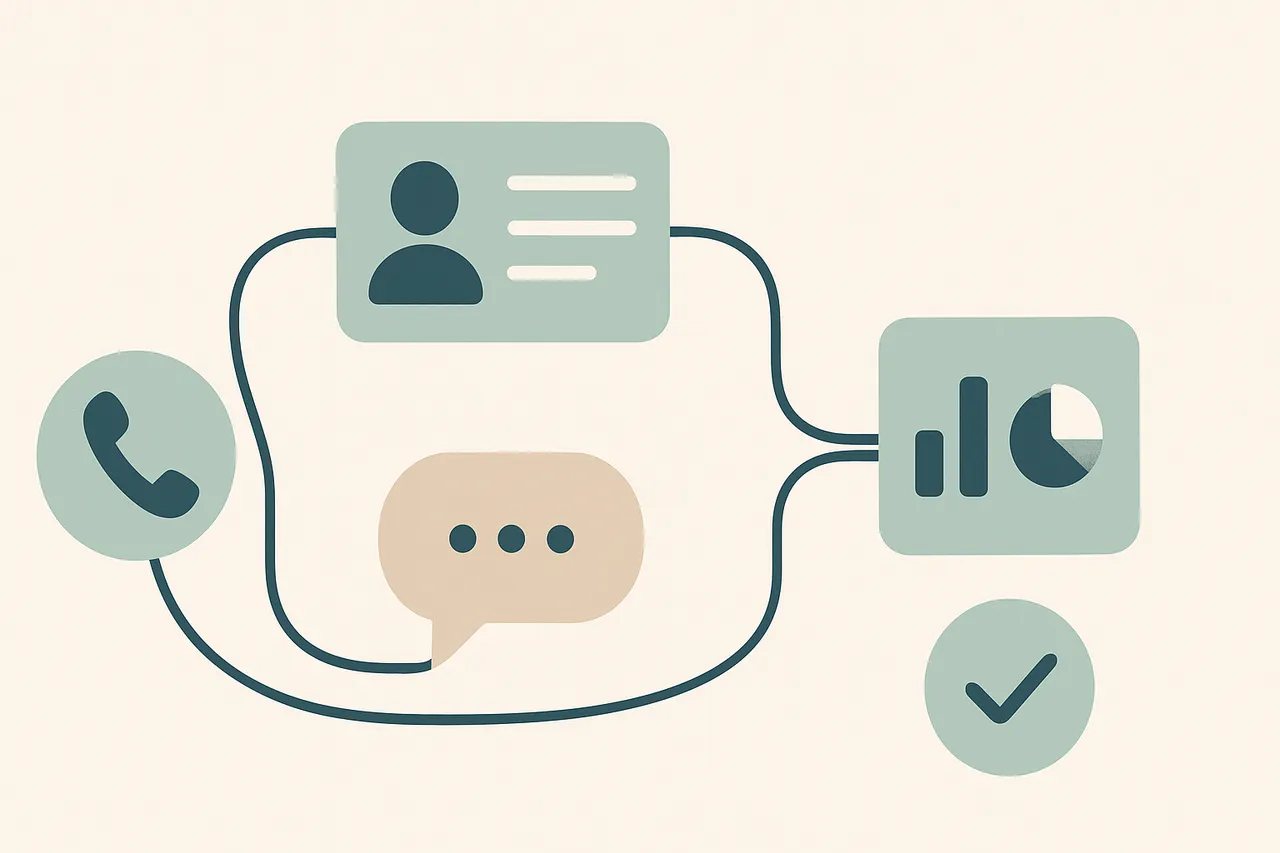
Last week we came across a job advert on a freelance platform. A company somewhere in America was looking for a senior CRM automation engineer, and they were willing to pay serious money for one. Adverts like this go up every day and most of them are forgettable. This one was not, because whoever wrote it did something unusual. They told the truth about their own business.
Three sentences in, the mask came off completely:
Sales happens in someone’s notebook. Customer information lives in five different places. The team says “we always do it this way” but nobody actually wrote down what “this way” means.
We read that and laughed, because it is not a description of one struggling company. It is a description of nearly every service business we have ever walked into, including our own for a good many years.
This post is about what that advert accidentally reveals: why CRM and automation projects genuinely fail, what businesses are actually paying for when they hire somebody senior to fix it, and what any of it means if you run a plumbing firm, a clinic, a garage or a computer shop and you know, quietly, that your own pipeline currently lives in a notebook too.
The three sentences that describe almost everyone
Take the confession apart line by line, because each sentence is a different disease with a different cost.
”Sales happens in someone’s notebook”
Every business has one. Sometimes it is an actual notebook, sometimes a phone’s notes app, a whiteboard, or one person’s memory. The problem is not that notebooks fail. They work brilliantly, for exactly one person, right up until the day that person is on holiday, off sick, or leaves.
Then the business discovers that its sales pipeline was never an asset of the company at all. It was an asset of an individual, and it has just walked out of the door. Every quote that was being chased, every callback that was promised, every “he said ring back in March”, gone.
”Customer information lives in five different places”
The email inbox has the enquiry. The phone has the texts. The invoicing system has the address. The job sheet has what was actually done. Somebody’s head has the context, that this customer is fussy about mornings, that the last job overran, that they mentioned a second property.
Five places means answering one simple question, what is happening with Mrs Patel’s job, requires an archaeology expedition. When the customer rings to ask, whoever answers has to bluff, because assembling the truth takes twenty minutes that the phone call does not have.
There is a second cost here that rarely gets counted. Customer records scattered across five systems are five places you have to think about under data protection law, and most businesses could not tell you what they hold or where. The ICO’s advice for small organisations is written for exactly this situation, and the government’s data protection overview is the plainest summary of the duties involved.
”Nobody wrote down what ‘this way’ means”
This is the quiet one, and it is the most expensive. Every business has a way of doing things. Almost no small business has written it down, which means the process exists only as folklore: passed on by shadowing, mutated with every retelling, enforced by whoever has been there longest saying “that is not how we do it”.
You cannot improve a process that is not written down. You cannot hand it to a new starter, you cannot automate it, and you cannot even see it. Undocumented process is why training somebody takes months, why the owner cannot take a fortnight off, and why the business is worth less than it should be if it is ever sold, because part of what is being sold is a set of habits inside people’s heads.
None of those three problems is a software problem. That is the point, and it is why the advert is considerably smarter than most of the software industry.
What they were actually paying for
Here is the remarkable part. This company was not short of software. They already had one of the most capable and most expensive CRM platforms on the market. They could have hired any of ten thousand freelancers who know where every button in it lives, most of them charging modest hourly rates.
Instead the advert said, in bold, that the job was not clicking buttons. It was understanding the business first and designing the system correctly afterwards.
The list with no software skills in it
What they actually asked for was somebody who can take a messy process and make it simple. Somebody who asks the right questions before building. Somebody who understands why the company does something, not just how. Somebody who documents things clearly enough for a non-technical person to follow. Somebody who can explain technical trade-offs in plain English.
Read that list again. There is not a single software skill in it. The platform knowledge appears further down, almost as an afterthought, as if to say: of course you can configure the tool, that is table stakes. What we are paying senior rates for is judgement about what to configure and why.
The market worked this out before the industry admitted it
Businesses at the sharp end are now explicitly paying a premium, often several times the button-clicker rate, for process understanding, and treating platform knowledge as the cheap commodity it has become.
If you have ever bought business software, been left with a login and a welcome email, and watched the subscription renew while nobody opens the thing, you have experienced the gap between those two purchases. You bought configuration. What you needed was understanding.
Why CRM projects actually fail
We can say this with a straight face because we have lived both sides of it. Manchester PC is a computer repair business. Long before we built systems for anybody else we were the company in that advert: quotes tracked in heads, customer history scattered across an inbox, a phone and an invoicing app, and a way of doing things that existed nowhere except in conversation.
When a CRM project fails in a small business, and a great many quietly do, the post-mortem is nearly always the same and nearly always misdiagnosed. The owner concludes that the software was rubbish, or that they are too busy for that sort of thing. Look closer and the sequence is almost identical every time.
| Stage | What happened | What it looked like from inside |
|---|---|---|
| 1 | The tool was bought before the process was understood | Software chosen like a kettle, on features and price |
| 2 | An empty system was handed over as a finished product | Import your contacts, invent your stages, train your staff |
| 3 | The system fought the folklore and the folklore won | ”That is not how we do it” beat the software every time |
| 4 | Nobody was accountable for it working | Everyone could truthfully say they did their bit |
The tool arrived before the understanding
Somebody chose software without first writing down what the business does when an enquiry arrives, who touches it, and what “done” means. That order is the whole failure in miniature.
An empty CRM is a project, not a product
It is not a solution, it is a job somebody has handed you. Import the contacts, define the stages, invent the categories, train the staff, change the habits. That job lands on the busiest person in the building, usually the owner, and it dies within a fortnight. Not because anybody decided to abandon it, but because Tuesday happened.
Folklore has seniority
If the software says one thing and the way we have always done it says another, the software loses. Every time. Unless somebody first made the folklore explicit, wrote it down, questioned it and got the team to agree what the process actually is, the shiny new system is just an opinion the business never agreed to.
Nobody owned the outcome
The vendor’s job ended at the login. The freelancer’s job ended at the configuration. The staff’s job was never made clear. Six months later the CRM contains eleven contacts, four of them duplicates, and everybody involved can honestly say they did their part.
At no point in that sequence did the software’s features matter. The project failed before the software was opened, which is exactly why the company behind the advert, who already owned excellent software, was paying senior money for a person who asks the right questions before building.
In praise of boring systems
Our favourite line in the whole advert is four words long: “We like boring systems.” Followed by the best justification in enterprise software: “Boring means reliable.”
Why impressive and reliable are usually opposites
This runs against every instinct the technology industry has. Demos are built to impress. Dashboards glow. AI features multiply. Every product wants to look like the future, so businesses buy the impressive thing and then discover that every clever moving part is another thing that can silently stop working on a Friday afternoon with nobody noticing until a customer shouts.
What boring actually looks like
A boring system is one where an enquiry arrives and, without anybody being brilliant, it gets acknowledged, logged, assigned and followed up. Where the same five steps happen the same way for the hundredth customer as for the first. Where the owner can go away for a fortnight and come back to nothing on fire, because nothing depended on their memory. Where a new member of staff can read a page, follow it, and get the same result as the person who wrote it.
Nobody films a demo video about that. But ask any service business owner whether they would rather have an impressive system or one that quietly works, and watch them answer before you finish the sentence. The advert described the reaction it wanted from a business owner perfectly: “Wait, that is it? It just works now?”
That reaction, slightly anticlimactic and faintly suspicious relief, is what a good system feels like from the inside. If your technology regularly makes you feel excited, something is probably about to break.
The documentation test
The advert dedicates an entire section to documentation. Not code quality, not certifications. Documentation, understandable by non-developers.
We would go further. Documentation is the whole game, and it is the sharpest single test you can apply to anybody who wants to build systems for your business, including us.
A system without documentation is a hostage situation
The business cannot change it, fix it or leave it, because the knowledge of how it works lives in one head that charges by the hour. We have inherited setups like this: tangles of automations somebody wired together where nobody left in the building knows what happens if you switch any of it off, so nobody ever dares. That is not a system, it is a superstition with a monthly invoice.
Documentation forces honest thinking into the open
You can bluff a configuration. You cannot bluff a plainly written page that says: when an enquiry arrives this happens, then this, and if nobody acts within this time, this is who gets told. Writing that page requires actually understanding the business, which is why people who cannot produce one usually have not.
The question to ask
Whatever you buy and whoever you hire, ask to see what a previous client was left holding. If the answer is a clear document a non-technical person could follow, you have found a builder of systems. If the answer is a shrug, you have found a future dependency, however good their code might be.
Where AI actually belongs in all this
The advert asks for AI experience: prompt design, AI-assisted automation, the modern toolkit. Notice where it asks. Near the bottom, after process understanding, after simplicity, after documentation. AI is listed as a way of improving workflows rather than as the point of the exercise.
That ordering is exactly right, and worth being honest about, because AI is currently being sold to small businesses the way conservatories were sold in the nineties. Aggressively, to everybody, whether or not the house needs one.
What it is genuinely good at
Running AI inside our own business every day has taught us where it earns its place. It is excellent at the connective tissue of a service business: answering the phone when everybody is mid-job and capturing what the caller actually needs, drafting the follow-up nobody had time to write, summarising a long back and forth so the next person catches up in thirty seconds, noticing a quote has sat unanswered for a week and nudging a human about it. Boring work, done reliably, at volume.
Where it does not belong
AI should not be deciding your prices, promising your customers outcomes, or publishing anything in your name without a person having read it. Our rule, in our own company and in anything we build, is four words: AI drafts, people decide. Some of our workflows are heavily automated. Some are mostly human with AI preparing the ground. A few we tried, watched carefully and pulled back from, because the results were not good enough for a business with a reputation to protect.
The duties that come with it
If AI is touching customer records, the accountability sits with your business rather than with whoever supplied the tool. The ICO’s guidance on artificial intelligence sets out what you need to be able to explain, and the NCSC’s briefing on AI and cyber security covers the risks that arrive alongside the savings. We cover the wider picture in our plain-English AI regulation timeline.
If somebody offers you AI without wanting to understand your process first, they are selling you a conservatory. Fix the process, make it boring, write it down, then let AI take over the repetitive parts under supervision. That order is not negotiable, because automating a mess simply produces mess at higher speed.
What this means if you run a small service business
That company could afford a senior engineer at serious rates to untangle them. If you run an eight-person heating firm or a two-person repair shop you cannot, and you should not need to. The diagnosis still applies exactly, so here is how to act on it at small-business scale.
First, find your notebook
Somewhere in your business something critical lives in one person’s head or one person’s pocket. The quote list, the callback promises, the way you price awkward jobs. You already know what it is, because you thought of it while reading this. That is your single point of failure, and making it visible, even on paper, is worth more than any software purchase you could make this month.
Second, write down “this way” for one process only
Not all of them. Pick the one that touches money most directly, which for most service businesses is what happens between an enquiry arriving and a quote going out. Write the steps as they actually happen rather than as they are supposed to. Get whoever does the work to correct it. You now own a documented process, probably for the first time, and every hire and every automation gets easier from that page onwards.
Third, count the gaps rather than the features
When you do look at systems, ignore the feature lists and ask where things currently fall through. Calls that ring out. Website enquiries answered two days later. Quotes never followed up. Finished jobs never followed by a review request. Each gap is money leaking invisibly, and each one is specific and fixable, which is a far better shopping list than “we should probably get a CRM”. We put numbers on one of those gaps in what missed calls actually cost, and wrote up what we did about our own inbox in how we sorted a chaotic shared mailbox.
Fourth, apply the advert’s tests to anyone you might pay
Do they ask about your process before talking about their product? Could they explain their proposal in plain English to your least technical member of staff? Will they leave documentation a normal person can follow? Do they seem pleased when the answer is boring? A supplier who fails those tests will leave you with a login and a renewal date. One who passes will leave you with a system, and the difference has nothing to do with which logo is on the invoice.
Fifth, be suspicious of anyone who leads with AI
Including us. If the first conversation is about artificial intelligence rather than about how enquiries move through your business, you are talking to the wrong end of the telescope. Understand, simplify, write down, then automate the boring parts with a person supervising. Our guide to what AI automation can actually do is deliberately written in that order.
Sixth, keep the new system secure
Anything holding your customer list is worth protecting properly, and a scattered setup is harder to secure than a single one. The NCSC’s Small Business Guide covers the fundamentals in plain English and takes about twenty minutes to read.
Why we can say this with a straight face
A fair question at this point is who we are to lecture anybody about this.
We are a computer repair business in Manchester. For years we were the company in that advert: the notebook, the five places, the folklore. We got tired of losing work through gaps we could not see, so we built ourselves the boring system the advert describes. Every enquiry captured and logged the same way. Every quote tracked with its follow-ups. An assistant answering our phone when we are mid-repair and writing down what the caller needs. A human deciding everything that matters.
We documented it because we kept forgetting our own decisions. We made it boring on purpose, because we had already lived with exciting and exciting kept dropping things.
Only then did we start setting the same thing up for other businesses. Everything we offer another company is running in ours today, which is also why we will happily talk you out of buying things you do not need. We know which parts earn their keep, because we pay for them too. If you want the longer version, it is on our about page, and the systems themselves are described under lead capture and follow-up and business automation.
We are early in that journey and we say so plainly: founding prices, a small number of clients we can look after properly, and measured results to follow rather than invented statistics.
The advert’s last word
The company closed with a line we would frame. They wanted an engineer excited not by building impressive things, but by the moment a business owner says “Wait, that is it? It just works now?”
That is the correct ambition for any system in any small business, and it has never once started with software. It starts with three honest sentences about notebooks, five places, and the way nobody wrote down. If those sentences describe your business, you are in the largest club in the country, and the exit is better mapped than it looks. Find the notebook, write down one process, count the gaps, and only then reach for tools. Boring ones, documented, with a human in charge of anything that matters.
If you would like company for that walk, we run a free systems review: a short conversation about where your enquiries come from, where they go, and where they quietly leak. Sometimes the honest outcome is a list of free fixes and a handshake. Either way you will know where your notebook is. You can book one here, or if you would rather have the whole picture measured properly first, that is what the AI Opportunity Assessment is for.
Frequently asked questions
Why do CRM projects fail in small businesses?
Almost always because the tool was bought before the process was understood. An empty CRM is a project handed to the busiest person in the building, and it dies within a fortnight. The software features are rarely the cause, because the project fails before anybody opens it.
Do I need a CRM or do I need something simpler?
If you cannot describe what happens between an enquiry arriving and a quote going out, you need the process written down before you need software. Plenty of businesses find that a single form and a follow-up reminder solves most of it for a fraction of the cost.
What does 'boring systems' actually mean?
A system where the same steps happen the same way for the hundredth customer as the first, without anybody being brilliant. Boring means reliable, and reliable is what lets an owner take a fortnight off without coming back to a mess.
How do I judge whether a supplier is any good?
Ask whether they want to understand your process before talking about their product, and ask to see the documentation a previous client was left holding. If a non-technical person could follow it, they build systems. If not, you are buying a dependency.
Where should AI fit in a small business?
After the process is understood, simplified and written down, not before. AI is excellent at the repetitive connective work: answering when everybody is busy, drafting follow-ups, summarising a long thread. It should not be deciding prices or publishing in your name.
What is the cheapest first step?
Writing down one process, the one between an enquiry arriving and a quote going out, as it actually happens rather than as it is supposed to. It costs an afternoon, it is worth more than most software purchases, and every later decision gets easier.
Read next
-
AI & automation
What Can AI Automation Actually Do? A Plain-English Guide
-
-
AI & automation
How Missed Calls Cost Business: The Real Price (2026)