
AI & automation
Most Callers Enjoy Talking to Our AI. That Surprised Us Too.
People ring us and have fun talking to an AI receptionist. Why an honest machine removes social debt, what the telephone and cash-only teach us, and why the enjoyment window has an expiry date.
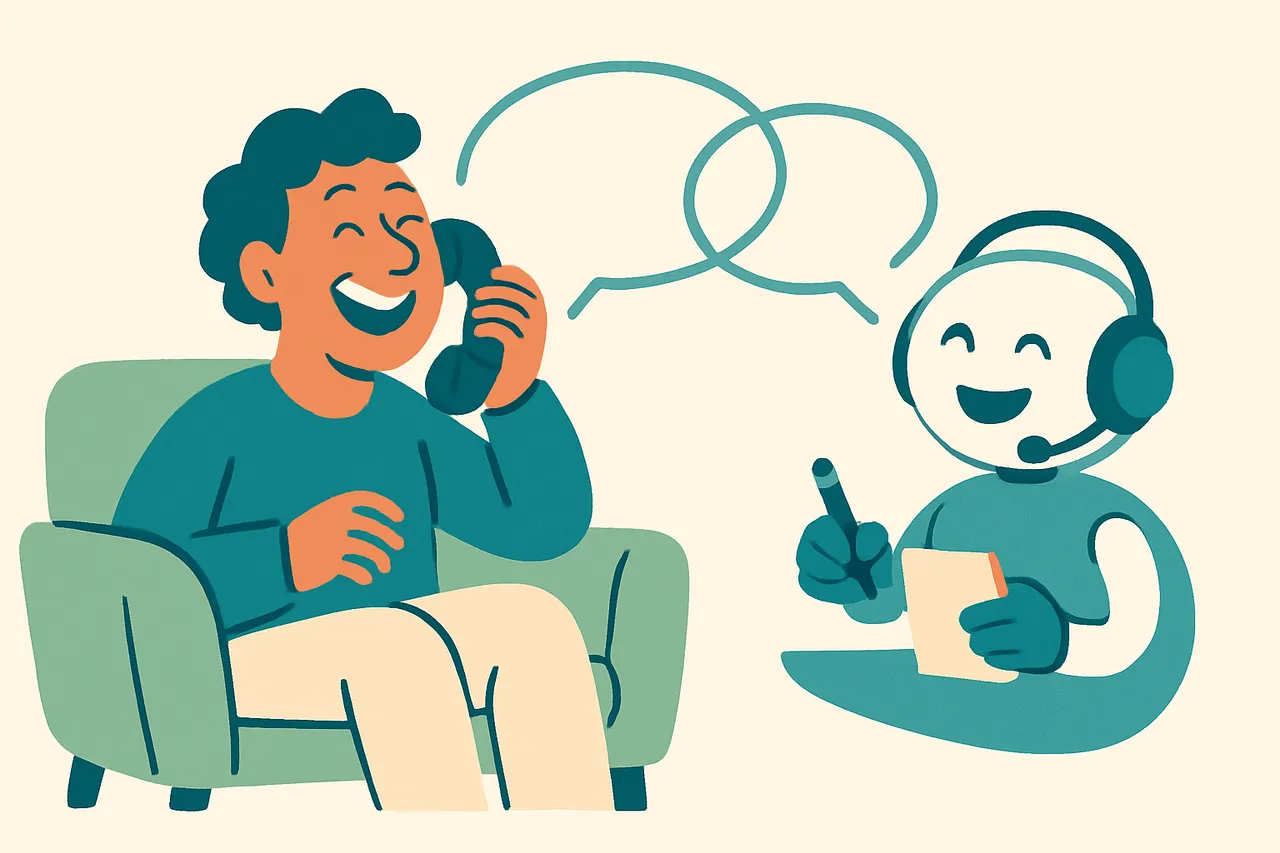
Most people who ring our business and meet an AI receptionist enjoy it, and that finding surprised us more than it will surprise you. If you run a small service business and you have been putting off voice AI because you assume customers will hate it, this post is the counter-evidence, along with the honest limits of it. By the end you will know why talking to a machine is genuinely pleasant for a lot of callers, why that pleasure has an expiry date, and what the telephone, the answering machine and the “cash only” sign tell you about which side of the change you want to be on. We are a Manchester repair and technology business that runs an AI on its own phone line before selling it to anybody else, so everything below comes out of our own call logs rather than a vendor’s brochure.
Why do callers enjoy talking to an AI receptionist?
Because it removes the small social tax that every phone call to a human quietly charges. Our business phone is answered by an AI voice assistant that introduces itself as exactly that in its first sentence. We review those calls the way other firms review CCTV: routinely, slightly tediously, looking for faults. In among the postcodes and the broken laptops we keep finding something nobody designed for. People are enjoying themselves.
It removes the social debt of asking
Every call to a person carries an invisible cost. You are taking up somebody’s time. You are aware they might be busy, tired, or quietly judging your question. You rehearse a little. You apologise for bothering them. You feel daft asking the obvious thing, “do you collect on Saturdays”, of a human who has answered it four hundred times and might, conceivably, sigh.
All of that vanishes when the voice on the line is a machine and says so. You cannot inconvenience it. You cannot bore it. It has answered “do you fix iPads” a thousand times with identical enthusiasm and will answer it a thousand more. There is no judgement to fear, no queue guilt, no closing time on its patience.
You can hear the difference in the recordings. Callers stop performing politeness and just say what they need. The older caller repeats herself without embarrassment. The teenager asks the question he would never risk on a person. The bloke ringing at nine in the evening about a dead laptop does not open with an apology for the hour, because he knows nobody’s dinner was interrupted. The machine gives people permission to be direct, and directness turns out to be what most people wanted from a phone call in the first place. The social performance was the cost, not the point.
Novelty is real, and it still counts in 2026
Stack the novelty on top and you get the rest of the effect. Conversational AI is no longer exotic in the abstract: Ofcom’s Adults’ Media Use and Attitudes research found that just over half of UK adults, 54 per cent, now use AI tools such as ChatGPT, Copilot or Gemini, up from 31 per cent the year before. The concept is mainstream.
The encounter is not. Ringing a local repair company, a plumber or a garage and having a capable AI answer the phone is still uncommon enough to be an event. When a caller expecting either a harassed human or the void of voicemail instead gets a warm voice that says “I am an AI assistant, how can I help”, something small and delightful happens. They have stepped into a piece of the future in the most mundane possible setting. That combination, familiar concept and rare encounter, is precisely the sweet spot: enough context not to be frightened, little enough exposure to still be charmed.
People play with things they are comfortable with
The third ingredient is play, and it is the most endearing thing about our species. Callers try to trip the assistant up. They ask if it is really a robot and laugh when it cheerfully says yes. They interrupt mid-sentence to see what happens. They ask its opinion on things no receptionist needs an opinion on. One caller, mid-way through booking a repair, stopped to ask how its day was going. Another simply handed the phone to a family member “to have a go”.
The assistant takes it in good humour and steers back to being useful, which is exactly what a good-natured human receptionist does with a mischievous caller. The play is not a problem to engineer away. It is a signal. Nobody plays with something that unnerves them.
Is this just novelty, or something more durable?
It is both, and separating the two matters because they have different shelf lives. One part of the pleasure is a market condition that will expire. The other part is structural and will not.
What will wear off
The wonder will. In three or four years an AI answering a trade’s phone will be about as remarkable as a booking form, and callers will stop asking whether it dreams for the same reason nobody marvels at a cash machine. The “you have to ring them, it is brilliant” reaction is a phase, and phases end. Any business planning its marketing around the novelty should understand it is borrowing something with a return date on it.
What will not wear off
The social debt point is permanent. The reason people ask a search engine embarrassing medical questions they would never ask a pharmacist is not novelty, and it has not faded in twenty-five years. A machine that cannot be bored, inconvenienced or made to sigh is structurally easier to ask things of than a person, and that will still be true when voice AI is as dull as a card reader.
So the enjoyment splits neatly. The delight is temporary. The ease is forever. Businesses that adopt during the window get both for a while, and keep the second half permanently.
Has this happened before? The telephone, the answering machine and the website
Yes, repeatedly, and with a consistency that makes each generation’s belief in its own novelty slightly embarrassing. Four examples, all inside living memory or close to it.
The telephone was once too strange to answer
In the 1870s, nobody had settled on how to answer a telephone, because talking to a disembodied voice was a genuinely new social act. The greeting we all use was a decision somebody had to make. Thomas Edison proposed “hello” in a letter dated 15 August 1877, which, as the Hagley Museum and Library records, displaced Alexander Graham Bell’s own preference of “Ahoy, ahoy”.
Consider what that implies. A technology now so invisible that we do not think of it as technology at all was once so unfamiliar that its inventors argued about the first word. Businesses installed telephones as curiosities, and customers played with them. Within a generation, a business you could not telephone was not quaint. It was suspicious.
The answering machine ran the same arc in miniature
When machines first started taking messages, large numbers of callers simply hung up, because talking to a tape felt absurd and faintly humiliating. Those who did leave messages often left jokey, self-conscious ones, precisely because the situation was novel. Then it normalised. Then it flipped: by the 1990s, a business whose phone rang out with no machine at all seemed disorganised. The thing that had been weird to talk to became weird to lack.
”Why would a chip shop need a website?”
That was a sensible question in 1997 and the punchline of one by 2007. Businesses that got online early enjoyed a decade of being the easy ones to find. The holdouts spent the 2010s explaining themselves to customers who had stopped listening, because “no website” had quietly stopped meaning traditional and started meaning possibly closed down. We have watched the same reasoning applied to AI, incidentally, by people making exactly the arguments their predecessors made about the web. If you want the long view of how we got from one to the other, we keep it in the story of AI so far.
And then there is “cash only”
The most recent completed example, and the one everybody feels. Cash has gone from universal, to charming, to mildly inconvenient, to a sign that makes part of the queue silently decide not to come back. Its share of payments has fallen far enough that the FCA now researches the UK’s cash infrastructure partly as a question of protecting the minority who still depend on it. That is what the end of an adoption curve looks like: the old default becomes a special need.
What are the four stages of adoption, and where does voice AI sit?
Every one of those examples ran the same four stages, and voice AI on the small-business phone line is currently crossing from the first into the second. The stages are worth naming because they tell you what a technology is worth to you at each point.
The four stages, and what each is worth
| Stage | What it feels like | What adopting buys you | Telephone | Business website | Card payments |
|---|---|---|---|---|---|
| 1. Novelty | Strange, fun, early adopters look eccentric | A story customers repeat | 1870s to 1890s | Mid 1990s | Contactless launch era |
| 2. Familiarity | Recognised, still notable | Advantage plus goodwill | Early 1900s | Early 2000s | Early 2010s |
| 3. Expectation | Assumed, absence is friction | Parity, nothing more | Mid century | Around 2010 | Late 2010s |
| 4. The flip | Absence is the remarkable thing | Removal of a black mark | Long since | Today | Today |
The pattern never reverses. No communication technology in the list above went backwards, and no business that adopted at stage one later regretted the timing. What changes is only the return: at stage one the technology is marketing, and by stage four it is maintenance. Same product, same monthly cost, completely different value.
Where the phone line sits in the summer of 2026
Somewhere in the crossing from stage one to stage two, and moving quickly. We can hear the transition in our own logs. A year ago the dominant first reaction was hesitation. Now it is recognition: “oh, you are one of those AI ones, brilliant, right, my laptop is knackered”, delivered in the tone people once used for their first contactless payment. Mild wonder, immediately followed by getting on with it. The play is still there, but it is becoming a garnish rather than the meal, and that is stage two arriving.
Why is the enjoyment window a marketing asset?
Because it hands a small business something it almost never gets cheaply: a reason to be talked about. This is the part of the argument that has money in it.
The pub test
People do not talk about good service. They talk about remarkable service, in the literal sense of service worth making a remark about. The cruel arithmetic of running a small trade is that you rarely get to be remarkable through operations. You can be punctual, tidy, fairly priced and skilled for twenty years, and you should be, but “they turned up when they said they would” is not a story anybody tells in the pub. It is the absence of a story.
“I rang a repair company at ten at night and a robot answered. Not a menu, a proper conversation. It took the whole thing down and texted me before I had put the phone down. Go on, ring it, I will wait.” That is a pub story, a group chat story and a show-the-grandchildren story, and it stars your business for less than the cost of one recovered job a month.
Word of mouth needs a vehicle
Small service businesses live on recommendation, and recommendation needs something concrete for the recommender to say. “He is very good” is loyal but inert. “Their AI answered at midnight and the callback came by nine” is loyal and portable, because it is specific, surprising and verifiable by anyone with a phone. During the window, the technology is not only answering your calls, it is writing your customers’ recommendations for them.
We are not speculating about that mechanism, we watch it work. Callers occasionally tell the assistant that somebody told them about it. The story recruits, which is the whole definition of word of mouth.
Early it is marketing, late it is maintenance
So the real question is not whether to adopt eventually. History has never once answered that question with no. The question is whether you adopt while it is still a story, or after the flip, when adopting buys nothing except the removal of a black mark. Every stage-one adopter in every previous cycle got the golden years free. None of those promotions ever ran twice.
If you are weighing that against the cost, we have published the honest breakdown of what an AI receptionist costs in the UK, including where the pricing hides.
When does “a real person always answers” stop being a boast?
At the moment enough of your competitors answer every call, which is closer than most owners think. This is the part of the post that will age most sharply, so it is worth being precise about.
What the boast actually promises
Some businesses advertise the absence of this technology as a virtue: when you call us, you get a real person, always. Today that positioning still works. It sounds warm, even premium, and the instinct behind it is exactly right, because customers do deserve to be dealt with properly. We would never mock it.
But look at what it promises against what usually happens. For most small businesses the real person is under a boiler, driving, serving somebody else or asleep. The honest translation of “we always answer personally” is often “your call will ring out, reach a mailbox nobody checks, and you will try somebody else”. The warm boast and the cold ring-out are the same policy experienced at different hours, which is the argument we made at length in what missed calls really cost.
The comparison is what changes
Right now an unanswered phone is compared with other unanswered phones. Everyone is in the same boat, so nobody sinks. As more of the businesses around you pick up every call, at midnight, in mid-August, mid-crisis, the boat empties.
A customer who has grown used to every other trade answering instantly does not experience your ringing phone as charming humanity. They experience it as the void, and they judge it the way you now judge a business with no card machine: not as principled, but as behind. The badge does not age into vintage. It ages into “cash only”.
The humans were never the problem
Here is the nuance that keeps this honest, because our whole company is built on not overclaiming. When a skilled human actually answers your phone, that remains the best possible experience, permanently. What becomes strange is not employing people. It is the gaps: the rings-out, the full mailbox, the Monday scramble through a weekend of missed everything.
The AI does not replace the human answer. It abolishes the void around it. Businesses that understand this get both, people when people are available and a capable, honest machine for the other eighteen hours. If you want the fair comparison of the three options, including where a human answering service genuinely wins, we wrote AI receptionist versus answering service for exactly that decision.
Who does not enjoy talking to an AI?
A minority, and they matter more than their numbers suggest. Policy of the house: no claim without its counterweight, so here is the other side properly.
The callers who want a human, and why they are right
Some people want a person immediately, on principle, and the number is not zero. In our experience they are a small fraction, they skew heavily towards complex or emotionally loaded situations, a bereavement, a dispute, something gone badly wrong, and they are completely right to want that. A machine that trapped such a caller in cheerful loops would deserve every bit of the resentment it earned.
The reason our logs look the way they do is that the design assumes this caller exists on every shift. The assistant says what it is in its first breath, it never pretends, and the human path, a message straight to the team with a promised callback or a live transfer in opening hours, is one sentence away at all times.
Enjoyment is downstream of consent
That is the underlying rule, and it explains the whole pattern. People have fun with a machine they were not tricked into and can leave at will. Remove either condition and the fun curdles immediately.
It is also where the technology is heading legally and culturally. Transparency about automated systems is the direction of travel in every serious piece of UK guidance, and the practical version for a small business is simple: say what it is, first sentence, no games.
Novelty gets thirty seconds, usefulness gets the rest of the call
This deserves its own line. A charming voice that cannot actually log the repair, check the postcode or take a proper message is a fairground attraction, and callers sense the difference between a toy and a tool with remarkable speed.
The delight in our logs is not produced by the accent or the jokes. It is produced by the combination: this is fun, and it is also sorting my problem out. Fun without function would trend briefly on the way to the bin. That is why we treat the capture side, what happens to the enquiry after the call ends, as the actual product, and why it feeds straight into lead capture and follow-up rather than sitting in a voicemail box.
What does the national data say about how people feel about AI?
It says something genuinely useful: people are anxious about AI in the abstract and considerably warmer about it in the specific. Both halves of that are worth knowing before you put one on your phone line.
In the abstract, AI worries people
The government’s own research is blunt about it. The Department for Science, Innovation and Technology’s public attitudes to data and AI tracker found 96 per cent of UK adults aware of AI, and 60 per cent had used an AI chatbot in the previous three months, so exposure is broad. But sentiment was mixed at best: 39 per cent expected AI to have a positive effect on them personally against 29 per cent expecting a negative one, and the words people most associated with AI included “scary” and “worried”.
Ofcom’s research points the same way on trust specifically: among adults aware of AI, 57 per cent said they would trust an AI-written news story less than a human-written one. Nobody should read those numbers and conclude the public is relaxed.
In the specific, the experience is different
Yet the same population, ringing a repair company about a broken laptop, has a nice time. That apparent contradiction is not a contradiction at all, and the reason is worth understanding.
Abstract AI is a category people have been taught to fear: job losses, deepfakes, systems making decisions about them without recourse. A voice assistant taking a repair booking is none of those things. It makes no decision about the caller, it holds no power over them, it is not pretending to be human, and they can end it whenever they like. It is the most benign possible encounter with the technology, and it arrives in a context where the alternative was voicemail.
The practical lesson for a small business is that general AI anxiety does not transfer automatically to your phone line, provided you do not do the things that trigger it. Do not deceive. Do not make decisions about people. Do not trap them. This is the same principle behind everything we build, and it is why the wider shift from software that answers to software that acts, which we cover in the rise of AI agents, needs approval steps wherever the consequences are real.
And the compliance part, briefly
Call recordings and transcripts are personal data, and the duty to handle them lawfully sits with your business rather than with whoever supplied the software. The ICO’s guidance on artificial intelligence and data protection sets out what you need to be able to explain, the government’s data protection overview is the plainest summary of the basics, and the NCSC briefing on AI and cyber security is worth ten minutes before you connect anything to a live line. Decide these at the start. Retrofitting them is where the cost is.
What would we honestly tell another business owner?
Adopt while it is still a story, and get two design decisions right, because those decisions are the difference between callers enjoying it and callers resenting it.
The two conditions that make it work
First, the machine must say what it is, in its first sentence, with no games. A caller who works it out halfway through feels tricked, and that costs more trust than the whole automation saves.
Second, there must always be a way to a human. Not buried, not after four attempts. One sentence away, at all times, including out of hours where it becomes a promised callback with a time attached.
Get those two right and the strange thing happens: people ring your business, talk to a robot, and hang up smiling. Get either wrong and you have bought yourself a complaints generator with a monthly fee.
How to test it in a fortnight without spending much
Start by finding out what you are currently losing, because most owners genuinely do not know. Count the calls that ring out for one ordinary week. Count how many of those callers ever rang back. That number is the honest baseline, and it is usually the most persuasive thing in the conversation.
Then run the assistant on overflow only, so it answers what would otherwise have gone to voicemail rather than replacing anything. Nothing is at risk, because the alternative for those calls was silence. After two weeks you will have call recordings of your own customers, which beats every claim on this page including ours. If you would rather map the whole picture before touching the phone, that is what an AI opportunity assessment is for, and it will happily tell you the phone is not your biggest leak if it is not.
Trades tend to see the sharpest results because the conflict between hands and phone is at its worst, which is why we set the whole thing out for trades and home services separately.
Try it yourself, genuinely, have a go
This is where a call to action normally goes, but for once the product is the demonstration. Ring 0161 660 0356. The assistant will answer, tell you exactly what it is, and take it entirely in its stride if you would rather test it than book anything. Ask if it is real. Interrupt it. Try your best accent on it. People do, daily, and it will still cheerfully capture whatever you actually need before you hang up.
If, somewhere mid-call, the thought occurs that your own customers might enjoy this too, that thought is the entire pitch and we have nothing to add to it except a straight conversation about whether it fits your business. If it does not fit, we will say so, which is a habit we explain at more length in how we work. The full detail of what we run is on the AI receptionist page, or you can just ask us a question and get a human answer, which remains available and always will.
We watch this happen every day, in the logs, in between the postcodes. People are having a nicer time on the phone than anybody expected. It will not stay remarkable forever, and that is exactly why it is worth doing now.
Frequently asked questions
Do customers actually like talking to an AI receptionist?
More than the industry admits. In our own call logs the common reactions are curiosity, amusement and relief rather than irritation, and a fair number of callers stay on to test the assistant after their actual question is answered. The two conditions that produce this are honesty about what it is and an easy route to a human.
Why would anyone prefer speaking to a machine?
Because it removes social debt. Ringing a person costs you a small amount of politeness tax: you might be interrupting, your question might be stupid, they might be busy. None of that applies to a machine that has answered the same question a thousand times, so people relax and simply say what they need.
Is the enjoyment just novelty that will wear off?
Partly, and that is the point. Novelty is a real but temporary market condition. Every previous communication technology, from the telephone to the website to contactless payment, opened a window where early adopters were talked about, and every one of those windows closed within a few years.
Should a small business say the AI is an AI?
Yes, in the first sentence, every time. Callers who work out mid-conversation that they have been talking to software feel tricked, and that costs more trust than the automation saves. Every pleasant call we review starts with the assistant saying plainly what it is.
Does 'a real person always answers our phones' still work as a selling point?
For now. The risk is that the boast usually describes an aspiration rather than a fact, because the real person is up a ladder, driving or asleep. As more competitors answer every call at every hour, an unanswered phone stops reading as principled and starts reading as behind.
Who does not enjoy it?
A minority who want a human immediately, on principle, and they are right to want that. They skew towards complex or emotionally loaded situations. The fix is not persuasion, it is design: say what the machine is, and keep a human one sentence away at all times.
Read next
-
AI & automation
AI Receptionist vs Answering Service: Which Is Right for You?
-
AI & automation
How Missed Calls Cost Business: The Real Price (2026)
-
AI & automation
AI Agents Explained: From Answers to Actions (2023–2026)