
AI & automation
AI Receptionist vs Answering Service: Which Is Right for You?
AI receptionist, human answering service or voicemail? An honest comparison of cost, capability and where each one genuinely wins.
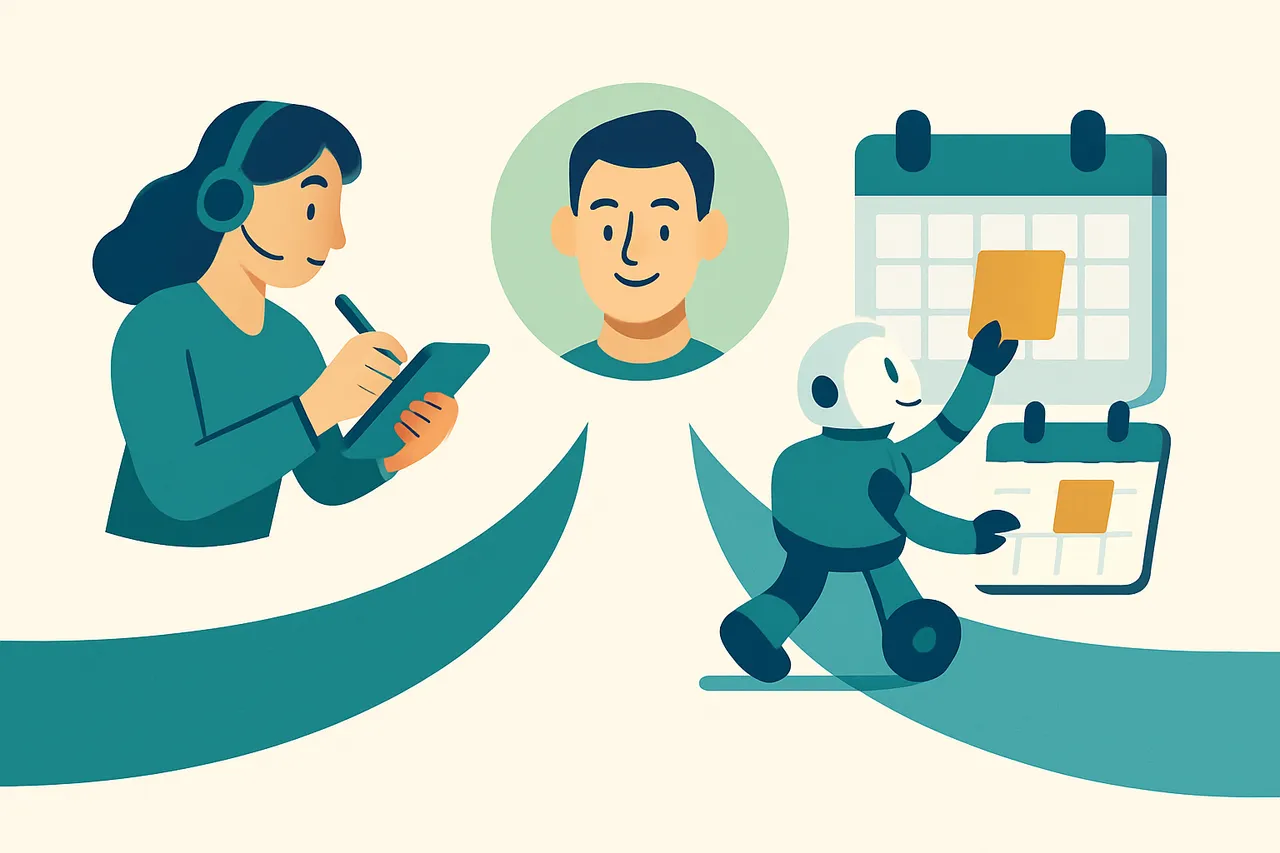
An AI receptionist answers instantly, never gets busy and costs a flat monthly fee; a human answering service handles nuance better and costs more per call. For most small service businesses the AI wins on the thing that decides the job, which is who picked up first. If you are choosing between them, or wondering whether voicemail is really so bad, this is the honest comparison. We are a Manchester technology business that builds AI call handling, so we have an interest here, which is exactly why the section on where humans win is the longest one.
What is the actual difference?
The two words get used interchangeably in marketing, and they describe genuinely different things.
An answering service is people
A traditional answering service, sometimes called a virtual receptionist, is a real person in a call centre answering in your business’s name. They take a message, sometimes follow a script, and pass it on. UK providers in this space have been doing it for decades.
An AI receptionist is software
An AI receptionist answers the call itself, holds a short conversation, asks the questions you told it to ask, captures the details and often books the work into your diary. There is no queue and no engaged tone, because it can hold any number of calls at once.
Voicemail is neither
Voicemail is a recording device. It does not qualify, book or reassure. It is included here because it is what most small businesses are actually using, and because it is the baseline both alternatives have to beat.
How do they compare directly?
| Voicemail | AI receptionist | Human answering service | |
|---|---|---|---|
| Answers instantly | Yes, badly | Yes | Usually, if lines are free |
| Handles several calls at once | Yes | Yes | No, callers queue |
| Asks qualifying questions | No | Yes, rules you set | Yes, script they follow |
| Books into your diary | No | Often | Sometimes |
| Handles emotional or unusual calls | No | Poorly | Well |
| Typical UK cost | Included | Flat monthly fee | Per call or monthly retainer |
| Cost when you get busy | Unchanged | Usually unchanged | Rises with volume |
| Works at 2am | Yes | Yes | Depends on the plan |
The row that decides most cases
“Handles several calls at once.” In a burst, whether that is storm damage for a roofer or a Monday morning for a plumber, a human service queues callers and an AI does not. The tenth caller in a busy hour gets the same answer as the first. That single property wins more work than any difference in warmth.
Where does a human service genuinely win?
This is the part most AI vendors skip, so here it is properly.
When the call is emotionally loaded
Bereavement services, healthcare, safeguarding, anything where a distressed person needs to feel heard. A person hears the tremor in someone’s voice and adjusts. Software does not, and pretending otherwise would be a bad recommendation.
When every call is different
If your enquiries genuinely do not follow patterns, an AI has nothing to learn from and will keep escalating. At that point you are paying for software to be a very expensive answering machine.
When the caller is the client relationship
Some professions are judged on who answers. If a long-standing client expects a familiar voice, automating that is a false economy however good the numbers look.
When regulation demands a human
Some regulated advice cannot be given, or even framed, by an automated system. If you are unsure whether that applies to you, it is a question for your regulator before it is a question for us.
Where does an AI receptionist win?
Four situations, and most trade and service businesses are in at least three of them.
The first to answer takes the job
In urgent local services, the customer rings until someone picks up. The firm that answers is the firm that gets the work, regardless of who was better. That is the whole argument, and it is set out with the arithmetic in what missed calls actually cost.
The phone rings when you cannot answer it
On the tools, under a sink, up a ladder, driving between jobs. This is not a scheduling failure you can fix by trying harder. It is the shape of the work.
Call volume is spiky
A per-call human service costs you most in exactly the weeks you are busiest. A flat AI fee does not move. For weather-driven or seasonal trades this is decisive, which is why we built a specific page for roofers.
You want the details captured the same way every time
Software asks the same questions in the same order and never forgets the postcode. That consistency is worth more than it sounds when the enquiry has to become a job.
Do AI receptionists really sound robotic?
This is the most common objection and it deserves a direct answer: not any more, but the concern behind it is legitimate.
What people are remembering
The robotic experience most people have in mind is the press-one-for-sales phone menu, which is a completely different technology and genuinely awful. Current voice systems hold a conversation, handle interruptions and do not require anyone to say “representative” four times.
Why we tell callers it is an assistant
Ours says so in its first sentence. That is a deliberate choice and we would argue it strongly: a caller who works out mid-conversation that they have been talking to software feels tricked, and that costs more trust than the automation saves. Transparency also happens to be where regulation is heading, which we cover in our AI regulation timeline.
The test that matters
Not “did it sound human” but “did the customer get what they rang for”. A caller who books a job in ninety seconds does not care what answered.
Ring your own number before you decide
Whichever way you are leaning, ring your own business line first and listen to what a customer currently hears. Most owners have not done this in years. If the answer is a voicemail greeting recorded by someone who left the business, or eleven rings and nothing, you have already learned more about your options than any comparison table will tell you. That is the baseline both alternatives are competing against, and it is usually worse than people remember.
How do you choose?
Three questions settle it for almost everyone.
One: what does a missed call cost you?
Average job value times calls a week you never return, times 52, halved. If that number is small, keep using voicemail and spend the money elsewhere. If it is large, the only question left is which option catches them. Full working is on our cost guide.
Two: how variable are your calls?
Mostly predictable enquiries point to AI. Genuinely unpredictable, sensitive or high-value conversations point to people.
Three: what happens when you are busy?
If your busiest week is also your most profitable, avoid anything that charges more when the phone rings more.
What are your obligations, whichever you choose?
This is the part that gets skipped in every comparison article, and it applies equally to both options. The moment something answers your phone on your behalf, you are processing personal data.
It is your duty, not your supplier’s
Call recordings, transcripts and the notes taken from a conversation are all personal data about a named person. Your supplier processes it, but the accountability sits with your business. “The provider handles that” is not an answer if someone asks you what you hold about them. The government’s data protection overview is the plainest summary of what that means, and the ICO’s advice for small organisations is written for firms without a compliance department.
Telling people they are being recorded
If calls are recorded, callers need to know. This applies to a human answering service exactly as much as to an AI one, and it is the kind of thing that is trivial to get right at setup and awkward to fix afterwards.
The AI-specific duties
Where an automated system is making or shaping decisions about people, extra duties apply. The ICO’s guidance on artificial intelligence sets out what you need to be able to explain, and the wider direction of travel is covered in our plain-English AI regulation timeline.
Security questions worth asking either supplier
Anything wired into your phone system and calendar is another route into your business. The NCSC’s Small Business Guide covers the fundamentals, and its briefing on AI and cyber security is worth reading before you connect anything to a live line. Ask where data is processed, how long it is kept, and who on their side can see it. A good supplier answers all three without hesitating.
Can you have both?
Yes, and for some businesses it is the right answer, though it costs more than either alone.
The usual split
AI takes overflow and out-of-hours; humans take the main line in office hours. You get instant answering when nobody is free and a person when one is.
When it is worth it
When your average job is valuable enough that the extra monthly cost is recovered by one saved enquiry, and when you genuinely have both types of call. If you are choosing a hybrid to avoid making a decision, you will pay twice for that comfort.
If you want help working out which of the three you actually need, our Never Miss a Customer page has the tiers and a calculator, and the trade-specific versions for electricians and plumbers go into the particular call patterns of each. If the honest answer for you is “none of these”, tell us what your week looks like and we will say so.
Frequently asked questions
What is the difference between an AI receptionist and an answering service?
An answering service is real people in a call centre taking messages on your behalf. An AI receptionist is software that answers, holds a short conversation, captures details and often books work. The people are better at nuance; the software is cheaper, instant and never engaged.
Do AI receptionists sound robotic?
Modern ones sound like a calm, clear person, and a good one says up front that it is an assistant. The awkwardness people remember is from older press-one-for-sales menus, which is a different technology entirely.
Which is better for emergency call-outs?
AI, in most cases, because it answers instantly and never has all lines busy. In an emergency the caller rings three firms and books whoever picks up first, so answering on the first ring matters more than answering elegantly.
Is a human answering service worth the extra cost?
It can be where calls are emotionally sensitive, highly variable or high value enough that nuance pays for itself. For routine trade and service enquiries, the extra cost usually buys warmth rather than more booked work.
Can I use both?
Yes, and some businesses do. A common split is AI handling overflow and out-of-hours, with humans on the main line during office hours. It costs more than either alone, so it needs a reason beyond wanting the best of both.
What about just using voicemail?
Voicemail is the option that loses the most work. Most callers with an urgent problem simply hang up and ring the next business rather than leave a message, so a voicemail box is often just a record of the jobs you did not get.
Read next
-

AI & automation
How Much Does an AI Receptionist Cost in the UK? (2026)
-
AI & automation
How Missed Calls Cost Business: The Real Price (2026)
-
AI & automation
AI Agents Explained: From Answers to Actions (2023–2026)